What changes for you
You stop guessing what a stranger will make of your codebase. You go into the conversation knowing where it is weak, with the parts you care about most already made sturdier, in the order you chose.
Technical due diligence is a reading of your product by people who have never seen it and have every reason to be careful. They tend to look for what anyone inheriting a codebase looks for: code with no tests, code that breaks when it is touched, and code that only one person on the team can explain. None of this is unusual. A product that grew quickly almost always carries some of each. What hurts is meeting it for the first time across the table, in someone else’s words.
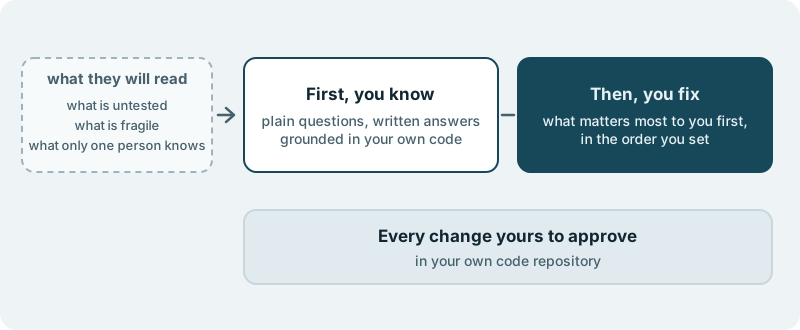
Carried for you, the work starts with knowing and moves on to fixing. You learn what is untested, what is fragile and what only one person understands. Then the parts that matter most to you are made sturdier, one change at a time.
You ask in plain words, and you get written answers grounded in your own code. Which parts of checkout have no tests? What would stall if our lead engineer were away for a month? Where does the billing logic live, and who could safely change it today? Each answer is about your product, not software in general, and asking changes nothing in the code. Asking anything about your codebase has its own page.
Written answers do a second job here. What one person used to carry in their head starts to exist in writing that your team, your co-founder and, if you choose, the buyer’s engineers can read.
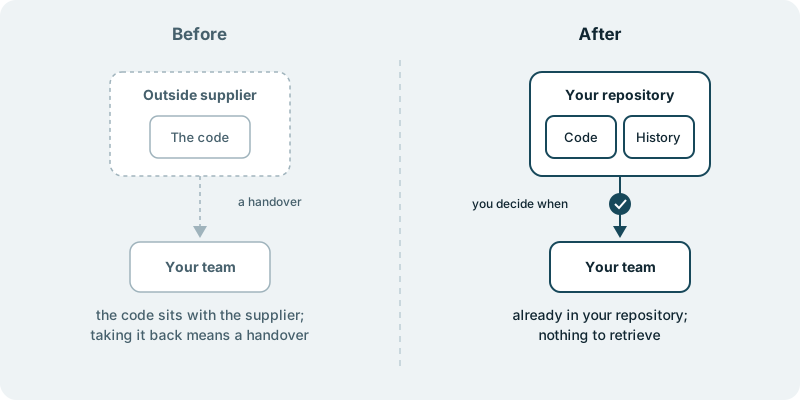
The work lands in your own code repository. The code we build for you is yours.
Access stays yours to set. We work within the access you grant, and nothing more.
What you decide
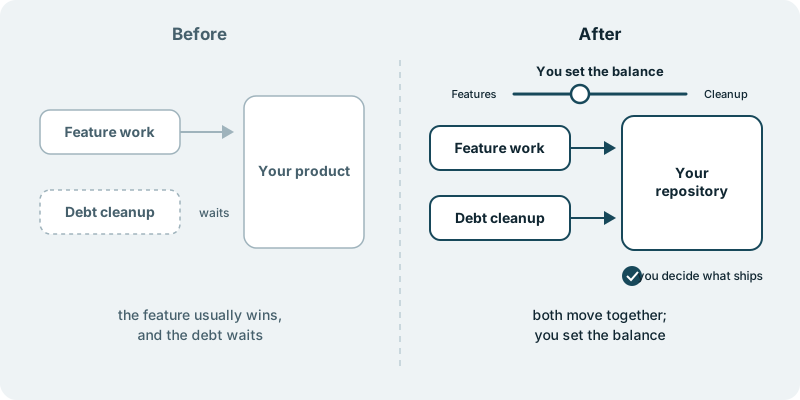
You decide what gets fixed first. The parts a buyer will look at hardest are rarely a mystery to you: the code your revenue runs through, the integration your largest customer depends on, the corner everyone avoids. You name them, and they come first.
You decide what is repaired and what is simply explained. Some weak spots are worth fixing; others are better left alone and described honestly. That is a business choice as much as a technical one, and it is yours.
You decide what ships. Nothing reaches your users without your approval.
What you see along the way
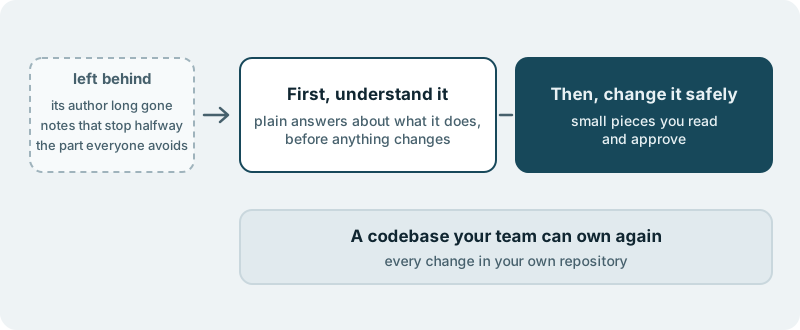
Changes arrive in your repository in small pieces your team can read and approve. Every change comes with a plain explanation of what it does and why.
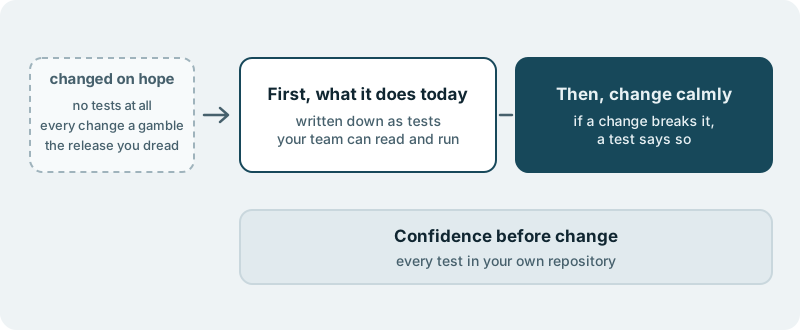
Where a part your buyer will care about has no tests at all, the first step is to pin down what it does today. Putting tests around code that has none covers that on its own.
What you will not see is a promise about the outcome. Nobody can tell you how a buyer’s engineers will judge your code, or what their judgement will do to a price. What you can have is fewer surprises on your side of the table, and answers you have already read.
What it costs you in time
Mostly the time it takes to ask your questions and to decide what comes first. Your engineers stay on the product, and they gain written answers to point to when the buyer’s questions come.
What if you want to stop
Every answer you received and every change you approved stays with you. Your code and your product stay yours to take anywhere. If the deal stalls, or never happens, the work done so far still leaves a codebase that is easier to own.
Start with one question: the one you would least like a buyer’s engineer to ask you. Ask it about your own code, read the answer, and decide what to fix. It starts with a conversation, with no obligation.