Your website is where buyers check that you are still the company they heard about. Too often it says what was true last spring.
What changes for you
Your website says what your company does now, and keeping it that way stops being a project somebody has to find time for.
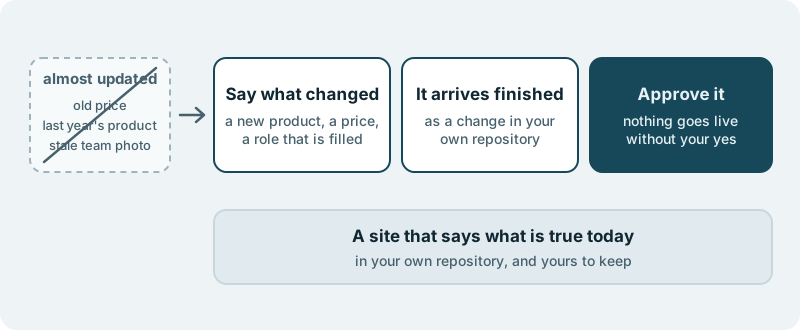
Most company sites drift in the same quiet way. The pricing changed, but one page still shows the old plan. The new product is in every sales deck and nowhere on the site. A colleague who left in the summer still smiles from the team page. The careers page lists a role that was filled months ago. Each fix is small, and each one waits: for the agency’s next free week, for an engineer to step away from the product, or for someone brave enough to open the editing tool without breaking the layout. The site is always almost updated.
Buyers notice. A prospect who reads one price on the site and hears another on a call starts to wonder what else is out of date. A candidate who finds a stale job advert wonders whether anyone is minding the shop.
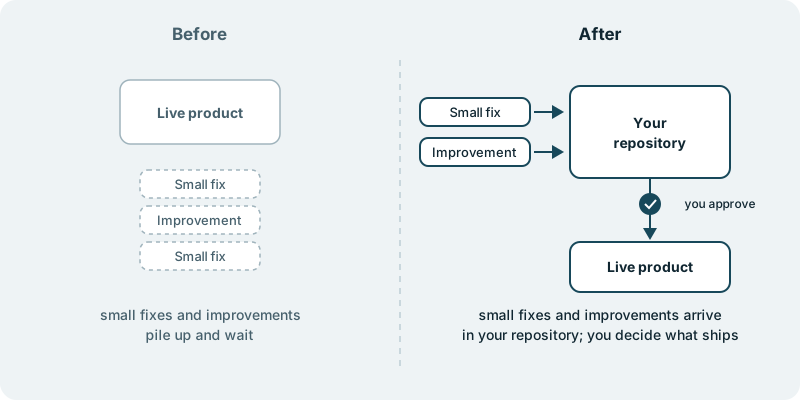
Zefana can carry the work for you: you set the direction, and finished changes arrive in your own repository for your approval. For a website, setting the direction means saying what has changed in the business: a new product that needs a page, a price that moved, an offer you have retired, a section that should speak to a new kind of buyer. The site follows your list, instead of your list waiting for the site.
The work lands in your own code repository. The code we build for you is yours.
What you decide
You decide what ships. Nothing reaches your users without your approval.
You decide what the site says. Your offer, your prices and your people are described in words you have read and accepted, and a sentence you would not say to a customer does not go up.
You decide what matters first. A wrong price costs more than an old news item, and you set the order.
You decide whether the current site is kept and improved or replaced. That choice is yours, made with your pages and your visitors in mind.
You decide who else may change the site. If your marketing team likes editing some pages itself, say so, and the site is shaped around that.
What you see along the way
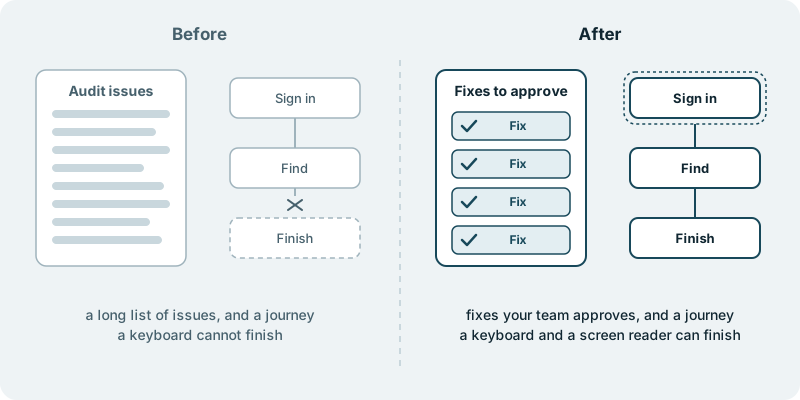
You see finished changes arrive in your repository, ready for your approval, instead of promises that the update is coming.
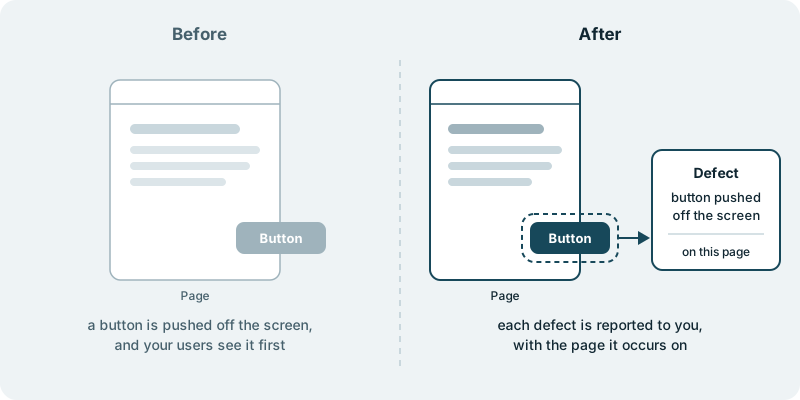
The gap between the business and the website stops hiding in someone’s inbox. You know what you have asked for, and what is waiting for you is a change you can read and approve, or decline with a word on what should be different.
What you no longer see is the old ritual around a small fix: the thread about who still has the login, the screenshot with the wrong price circled in red, the reminder that nobody answered.
What it costs you in time
Mostly the time it takes to say what has changed in your business, which is the part only you know. After that, your attention goes to reading the changes that are ready and deciding which ones go live.
What if you want to stop
The pages finished so far are already in your repository, and nothing you have not approved is on the site. Your code and your product stay yours to take anywhere. Your own team, or anyone you choose, can carry on from there.
The site you are reading
The site you are reading is our own example. This website is built and maintained with Zefana. It is a company website like the one this page is about, and you can judge for yourself whether it reads as current.
A first step
For your own site, a sensible first piece is the one page that is most out of date today. Tell us what it should say, then decide whether the change goes live. Every engagement is tailored to your product and your goals. It starts with a conversation, with no obligation.