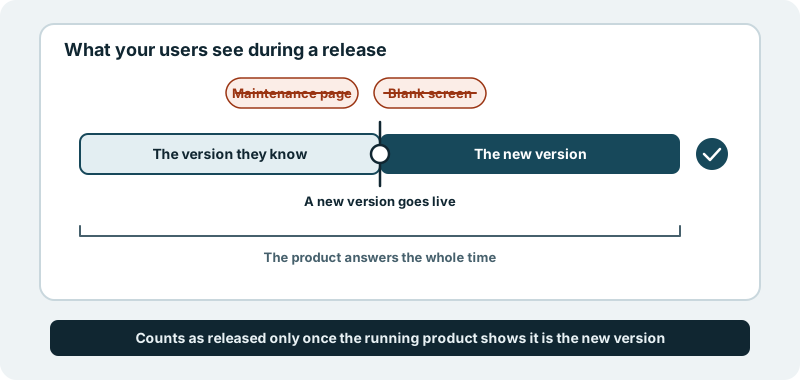
A new version of your product goes live while people are using it, and they carry on. There is no maintenance page, no blank screen and no request to come back later. A release only counts as done once the running product shows that it really is the new version.
What you get
Your users stay in the middle of what they were doing.
Here, going live is not something your users take part in. Three things change for you.
No downtime notice to write. A new version does not need a maintenance window, so there is nothing to announce and no apology to send. Customers in other time zones are not asked to wait for your quiet hour.
Releases can be small and frequent. When going live costs your users nothing, there is no reason to save changes up. Improvements reach people when they are ready, in pieces small enough to understand, instead of in a large batch every few weeks.
“Released” means released. You are not told a version is out while your users are still on the old one, or while it has quietly failed to start. A release only counts once the running product shows it is the version that was shipped. The status you hear and the product your users reach agree.
What it does not do
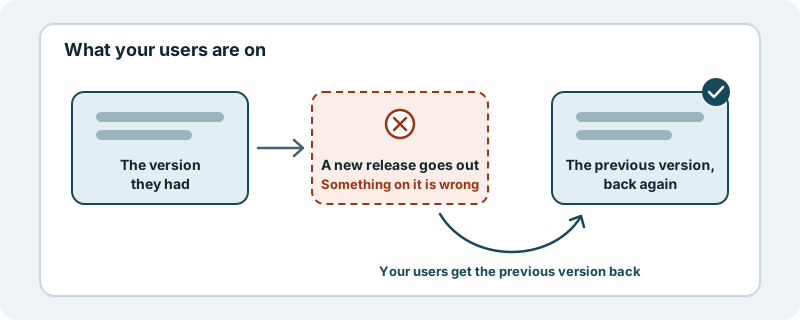
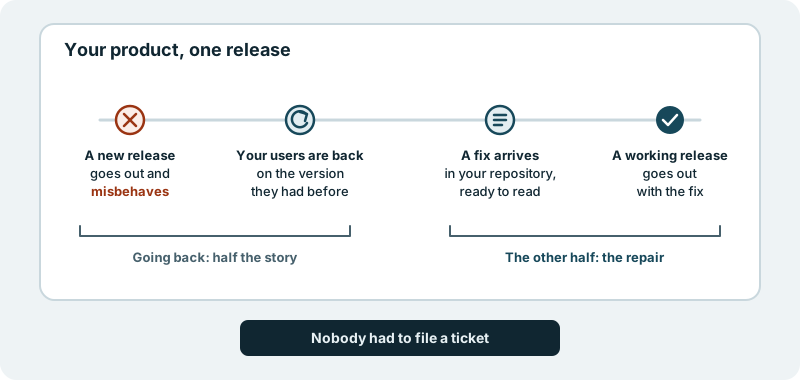
It does not promise that a new version is free of mistakes. Going live without a pause and behaving well afterwards are two different things, and the second is covered by releases that put themselves back and broken releases repaired. It also does not hide changes that are meant to be seen. If a release moves a button or changes a page, your users will notice the change itself, just not the moment it arrived. And for a few kinds of product, going live can still mean a pause of a moment; we tell you up front if yours is one.
What it looks like in practice
Picture a booking product with customers across several time zones. A small change to the confirmation step is ready on a Thursday morning.
With this in place, the change simply goes live. A customer who opened the booking page a minute before finishes their booking without a break, and the next customer sees the new confirmation step. Your team hears that the release is out only once the product people actually reach is running the new version. Nobody stayed up, and nobody had to say sorry.
Our own product is the proof we point to. This website (our own product): This website is built and maintained with Zefana.
How we do the work stays confidential, as your work with us does. What stays visible to you is every release, and the product your users reach.
If you would like to see it on your own product, we can start with one small piece of work and you can judge it by what your users do not notice.