What changes for you
You go from “we should sell online” to a shop that is open for orders, and that you own.
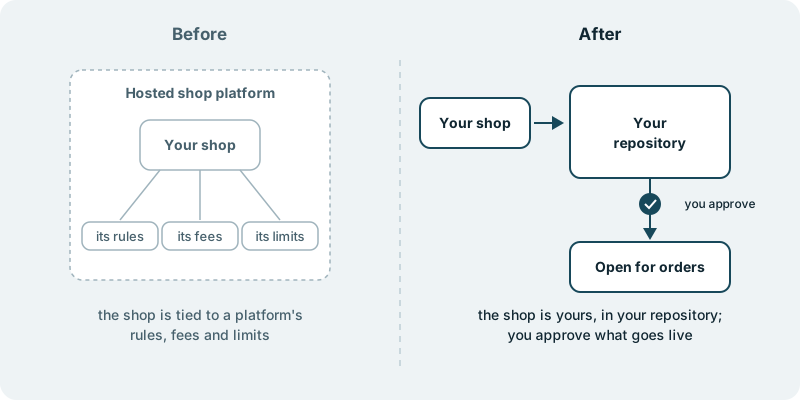
Many leaders reach this point the same way. The idea has been on the list for a long time. A hosted shop platform is quick to start but ties you to its rules, its fees and its limits. A custom build sounds right, but it needs a team you do not have and a brief you have not written. So the decision waits, and the sales you could have had go elsewhere.
A new shop built for you removes that wait. You describe what you sell and who you sell to. The shop takes shape, and you can lift your eyes to the business questions, such as range, prices and promotion, while the details are carried for you.
The work lands in your own code repository, and the code we build for you is yours.
What a first month can look like
The first conversation is about your customers, not about software. What do you sell, who buys it, and how do they find you today? Maybe it is a catalogue that currently lives in a spreadsheet and a handful of email threads. Maybe it is a physical shop whose regulars keep asking whether they can order from home. Maybe it is a business-to-business range where every order is still a phone call.
From there, the aim of a good first month is modest and concrete: a small, real shop that you can open on your own phone, click through as a customer would, and judge with your own eyes. You react to something you can see rather than approving a document. That reaction, more than any brief, is what shapes the next step.
What you decide
You decide what the shop is for. A small range with a handful of products, a large catalogue, a shop for business buyers, or a shop that supports a physical store are different jobs, and the first conversation settles which one this is.
You decide how it looks and feels, and what comes first. If you would rather open with a simple version and add features once orders arrive, the order is yours to set and to change.
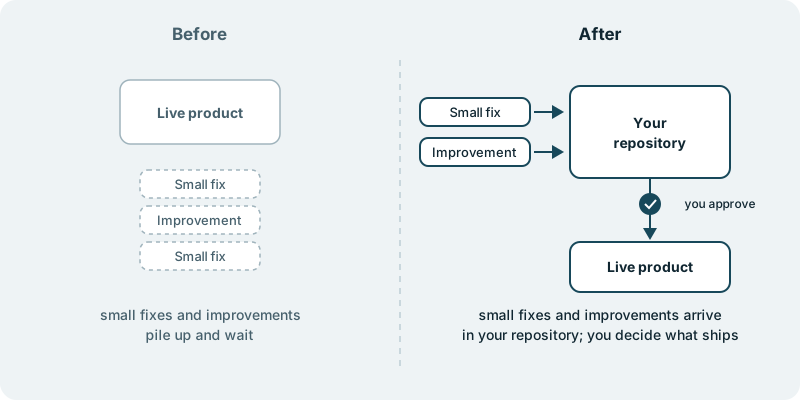
You decide when it goes live. Nothing reaches your customers without your approval.
You decide where it goes next. When the shop is open, you can keep us on to improve it, hand it to your own team, or move it elsewhere. Your code and your product stay yours to take anywhere.
What you see along the way
You see the shop, not a plan about the shop. Progress arrives in your repository in small pieces that you, or your team, can read and approve. You are told in plain words what each change does and why it is there.
You see the questions that are yours to answer, set before you with the options, rather than guessed at for you.
You see a way to say no. If something is not what you meant, you say so and it changes.
The way we work stays our own business. What stays in front of you is every change, before it goes live.
What stays your worry, and what does not
Choosing to sell online brings questions that only you can answer: what the range should be, how you want to be seen, how you want to treat returns, which markets you serve. Those stay with you, and they are the interesting ones. The routine pieces around them are what you stop carrying, so that your attention goes to customers and not to the plumbing.
What it costs you in time
A first conversation, a few decisions in the early days, and a short read of each change as it arrives.
What if you want to stop
You can stop at any point. There is no handover to negotiate and nothing to retrieve, because the shop and its code have been yours from the first day. Whatever has been finished is already in your repository.
Starting small
We have not published a delivered example for this situation, so we will not pretend to one. What we can do is begin with a small first piece, such as the first few products and the path from browsing to ordering, and show you what it looks like before you commit to more. Every engagement is tailored to your product and your goals, and it starts with a conversation, with no obligation.
If a shop has been on your list for too long, tell us what you would sell first.