What changes for you
You stop dreading the questionnaire.
A large customer sends a security questionnaire as part of a purchase. Or a regulation sets a date. The NIS2 Directive and the Cyber Resilience Act are two that European product teams now hear about in planning meetings. We do not interpret them for you, and we never promise compliance. Read them at the source, with your advisers, and decide what applies to you.
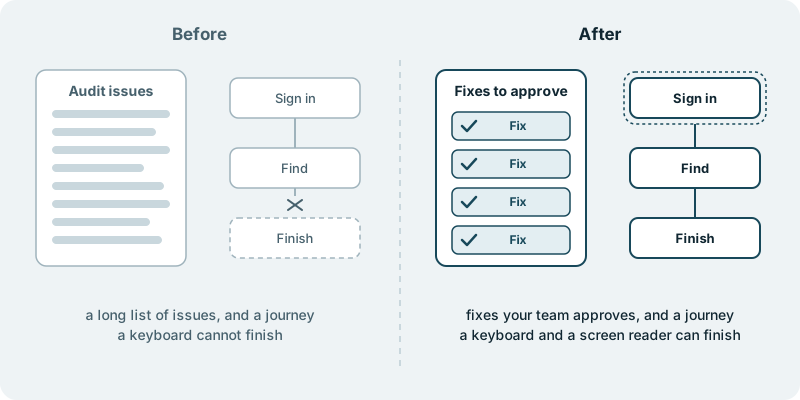
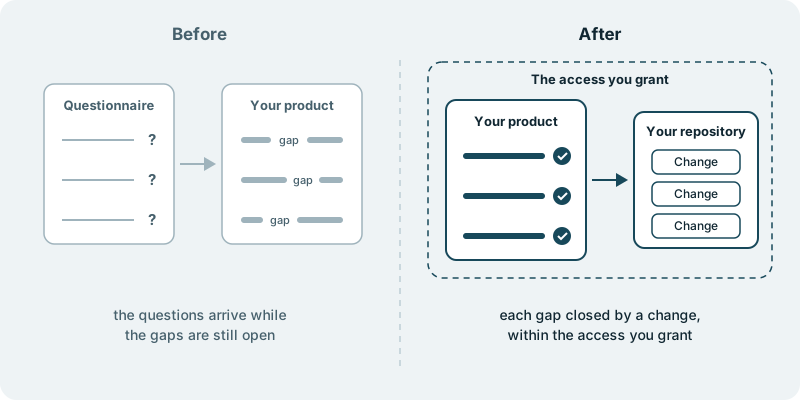
What we can do is the other half. Once you know what you are being asked, the questions become work. Each gap in the product turns into a change that closes it.
The effect is practical. Your team keeps its attention on the roadmap, and the product becomes harder to fault.
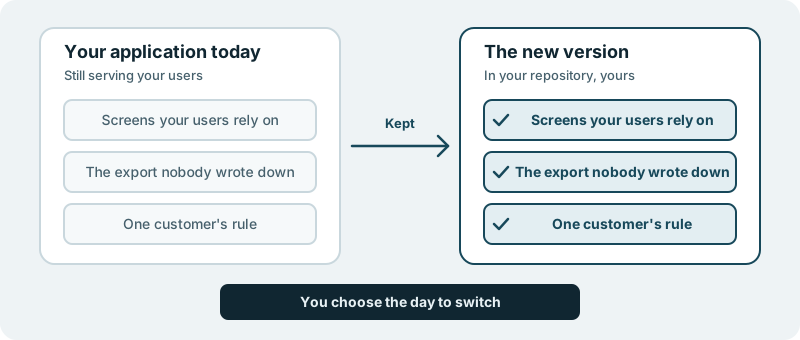
All of it lands in your own code repository, and the code is yours.
We want to be plain about what this is not. It is not a certificate. The site makes no claim of certification, and nothing here should be read as one. It is a way to bring your product closer to what your customers and your regulators are asking for, one closed gap at a time.
What you decide
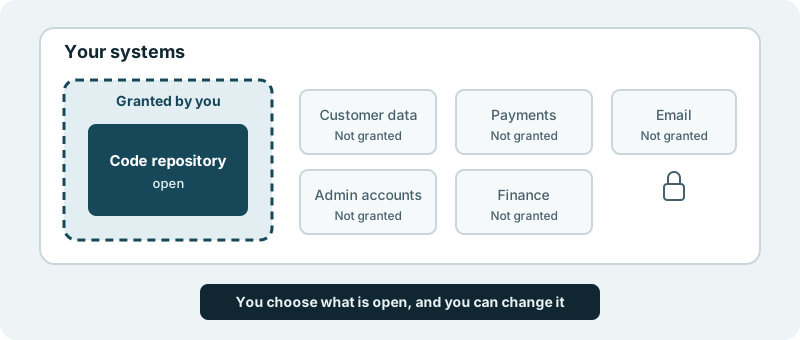
You decide the access. We work within the access you grant, and nothing more. If you want a first piece limited to one service, one repository or one part of the product, that is how it will be. If you later want more, you say so.
You decide what counts as a gap. You may begin from a questionnaire you have already received, from the text of a regulation you have read, from a report written by someone else, or from your own list of worries. We start where you point.
You decide the order. Some gaps are urgent because a deal depends on them. Others can wait for a quieter quarter. If a priority changes because a new customer asks a different question, the order changes with it.
You decide what is out of scope. Parts of the product that are about to be retired, or that you would rather your own people handle, stay as they are.
You decide how involved your team is. Some leaders want their engineers to read every change and learn from it. Others want the work carried for them and a short plain summary at the end. Both are fine, and you can move between them.
You decide how far to go in one step. A small first piece is a sound way to begin.
What you see along the way
You see changes, not promises. Each one arrives in your repository in small pieces your team can read and approve. Every change comes with a plain explanation of what it does and why.
You see your questionnaire shrink. If you started from a list of questions, you can follow it down. Each closed gap is a question you can answer with more confidence, and in your own words.
You see an honest edge. We tell you where the work stops. Questions about your company’s policies, your people or your contracts are not questions about code, and we will say so rather than pretend.
How the work is carried out stays confidential, as your work with us does. What stays visible to you is every change before it ships.
If this is new to your team, begin with one part of the product that worries you most, or with the three questions on the questionnaire you like least. Grant access to that and nothing else. You can stop at any point with everything finished already yours.