- Your largest customer asks for something no one else needs, and a yes feels like the safe answer.
- Each such yes is small. Together they can turn the product without anyone choosing to.
- Listen fully, keep the problem under the request, and decide against your direction, not against the volume.
The request arrives with weight behind it. It comes from the account that pays the most, through someone senior, often with a renewal in view. It is specific: a report in a certain shape, a setting for one team, an integration with a tool only they use. Nobody else has asked for it. Everyone in the room knows that saying no will be uncomfortable, and saying yes looks like good service.
So the answer is usually yes. And most of the time, one yes does no harm. The trouble is what happens across a year of them.
How a product drifts without anyone choosing it
A product rarely changes direction in a single decision. It changes through many small ones, each made for a good reason, none of them weighed against where the product was meant to go.
Every special case has to be built, and then kept working. It appears in the settings, in the help pages, in the testing of every later change. It takes a little of the attention that would have gone to the work you chose. Add a handful of these and the roadmap starts to describe one customer’s business more than your market.
The hard part is that this drift is invisible from inside each decision. Look at any single request and it seems reasonable. Only when you step back and look at the whole year do you see that the course has bent.
Listening is not the same as agreeing
The answer is not to stop listening to your biggest customer. They know their work well, they use the product hard, and they often notice a weakness before anyone else does. A leader who waves them away loses the most detailed view of the product there is.
What helps is to separate two things that arrive together: the problem the customer has, and the solution they have asked for. Customers are good at the first and less reliable at the second. They describe the fix that would work inside their own walls. That fix may be the wrong shape for everyone else, while the problem under it is real and widely shared.
So listen all the way through. Ask what they were trying to do when they first wanted this. Ask what they do today instead. Write the problem down in their words, and keep it, whatever you decide about the feature.
Four questions to ask before a one-off becomes the roadmap
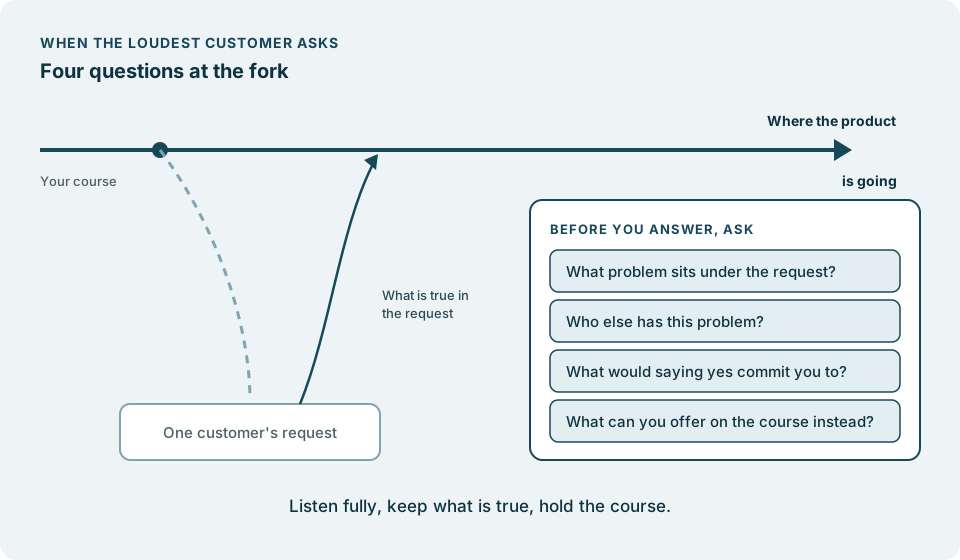
Before you answer, take the request through four questions. They turn a test of nerve into a decision.
What problem sits under the request? Restate it without the solution. “They need to send figures to their finance team every month” says more than “they want a custom export”. The first can be met in many ways. The second has only one.
Who else has this problem? Not who else has asked, but who else is likely to recognise it. Look at what other customers already say and do, and at the people you hope to win next. If the honest answer is nobody, that is useful to know. If it is many, the request may be a gift that came with the wrong label.
What would yes commit you to? Count the keeping, not only the building. A feature has to keep working through every change after it, be explained to new users and be supported when it breaks. A yes for one customer is a cost every customer shares.
What can you offer on the course instead? Often there is a smaller answer that serves the problem and fits the direction: a general version that helps others too, a change already planned that covers most of it, or a plain way to do the job without new work. Offer that, and say why.
If a request passes these questions, build it gladly. Saying yes to the right detour is part of steering. The point is that it becomes a choice, made in the open, rather than a turn nobody noticed.
Holding the course is a kindness, too
A steady course is easier to steer by than a busy one. When you have a few clear directions, the conversation with a demanding customer changes. You are no longer weighing their request against your nerve. You are weighing it against something written down, which you can show them.
We have written separately about keeping a few directions in view and saying no to the details. This essay is about the moment those directions meet the customer who matters most to the business.
That conversation can be generous. Tell the customer what you heard, in their words. Tell them which part of it you will carry forward and which you will not, and why. A clear reason is easier to respect than a vague yes that later goes quiet. Some customers chose your product for where it was heading. Keeping it on that course serves them as well.
There is also a quieter benefit, inside the team. When the people doing the work see a request weighed openly against the direction, they learn what the direction really is. The next time, they can ask the four questions themselves.
A place to begin
Take the last three requests from your largest customer, whatever you did with them. For each one, write down the problem underneath, who else has it and what it has cost to keep. Then hold the list beside your directions and see whether the course has stayed where you set it.
That is the part of the work that stays with you. “You set the direction. We carry the work through to shipped software.” If you would like more of your attention on the course and less on the detours, let’s talk. “It starts with a conversation, with no obligation.”