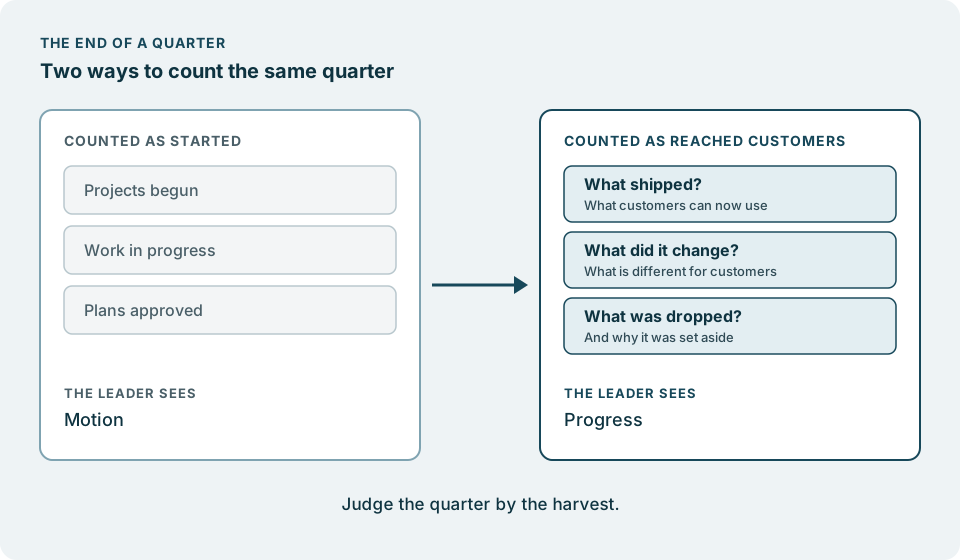
- Counting what was started shows motion. Counting what reached customers shows progress.
- At the end of a quarter, ask three things: what shipped, what changed, what was dropped.
- The quarter is judged by what customers can use, not by how busy it looked.
The last week of a quarter has a familiar shape. Teams gather their updates. Slides fill with projects begun, streams of work in flight and plans signed off. The room feels full, and the quarter looks like it went well. Then someone asks what a customer can do today that they could not do in the spring, and the room goes quiet.
That quiet is worth listening to. It is the gap between motion and progress.
Motion is not progress
Motion is what a team starts. Progress is what reaches the people the product is for. Both are real, and both take effort. Only one of them changes anything for a customer.
A quarter full of starts can feel productive from the inside. Every team is busy, every plan has an owner, every stream has a status. But work that is started and not finished has given nobody anything yet. It is a promise the product has made to itself. Half-built work is not worth half of finished work. It is worth what a customer can use from it, which is often nothing.
None of this says starting is wrong. Products need new work begun. The point is narrower: when you judge the quarter, starts belong in the plan for the next one, not in the account of this one.
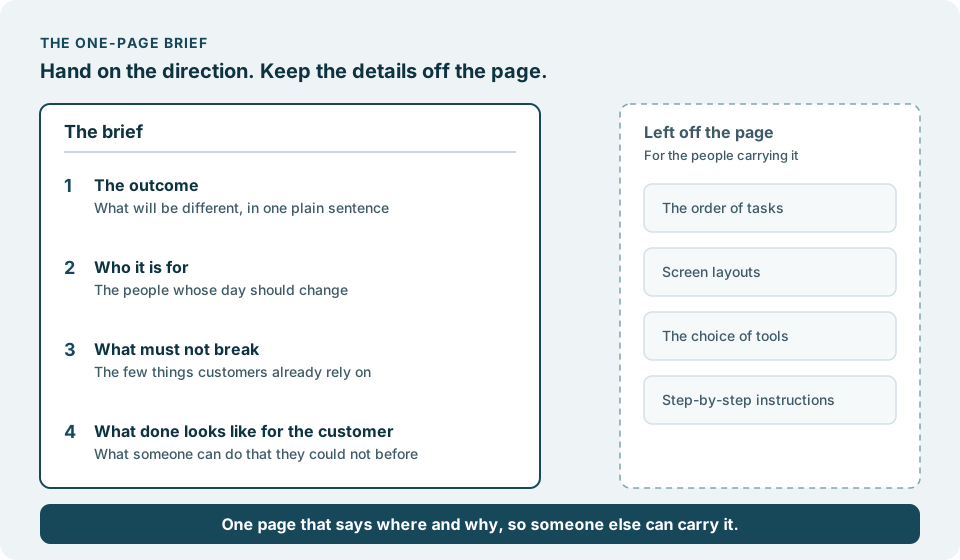
We have written separately about what “done” means when you set direction: a definition you set for each piece of work. This essay is about the review at the end of the quarter, when you look back across all of it at once.
Why starts are tempting to count
Starts are visible early. A project that began in the first week of the quarter has a name, a team and a status from day one. Something that reached customers in the last week has had little time to show what it changed. So the review leans toward what is easy to see, and what is easy to see is what began.
Starts also flatter everyone. Each one says the team said yes to something. Counting what shipped is less comfortable, because it shows what did not. That discomfort is useful. It is where the next quarter’s better choices come from.
Three questions for the end of a quarter
A good quarter review fits on one page and answers three questions. They are simple to ask and harder to answer well, which is why they are worth the time.
What shipped? List what reached customers this quarter, in words a customer would recognise. Not the internal name of a project, but the thing someone can now do, see or stop worrying about. If a piece of work is in the product but switched off, or finished but not released, it goes on a separate list. Be strict here. The list is shorter than the slides, and it is the honest one.
What did it change for customers? For each item, say what is different for the people who use it. Fewer steps to finish a task, a question they no longer have to ask support, a page that now works for someone who could not use it before. Some changes will be clear. Others will still be too early to judge, and it is fine to say so. What matters is that the question is asked about every item, not only the ones that went well.
What was dropped, and why? Every quarter ends with work that was set aside. Some was stopped on purpose, because something more important came along or because it turned out not to matter. Some simply drifted. Name both. A stop made on purpose is a decision, and a sign of a leader steering. A drift is a cost nobody chose, and the review is the place to catch it.
These three questions leave out a lot. They do not ask how many hours went into the work or how many tasks were closed. That is deliberate. Those numbers describe the effort, and the effort was never the goal.
The harvest is the honest measure
At the end of a season, nobody judges the field by how much was sown. They judge it by what was gathered in. The sowing mattered, and the patient work in between mattered, but the measure is the harvest.
A quarter works the same way. What reached customers is what the quarter produced. Everything else is either on its way to that, or it is not, and the review should say which.
There is a quiet relief in judging this way. You no longer have to defend a full slide of starts, or explain why so much is still in flight. You bring a shorter list that holds up to any question about it. The conversation with your board, your peers or your team gets simpler, because it is about what customers got.
What changes when you judge by what shipped
The first change is in planning. When the review asks what shipped, the plan for the next quarter starts to favour fewer things carried through over many things begun. Teams finish more of what they start.
The second change is in how the team talks. Updates move from “we are working on” to “customers can now”. That is a small change in words and a large one in attention. It turns attention from the tasks to the people the tasks are for.
The third change is in what gets dropped. A review that names dropped work makes stopping something a normal, visible choice. Work that should end ends sooner, and the time goes back to work that matters.
A place to begin
You do not need a new framework for this. At the end of this quarter, before the slides, write the three lists by hand: what shipped, what it changed, what was dropped and why. Share them with your team and ask what is missing. Then put the slides next to them and see which tells the truer story.
If you want more of your next quarter to end on the first list, let’s talk. “It starts with a conversation, with no obligation.”