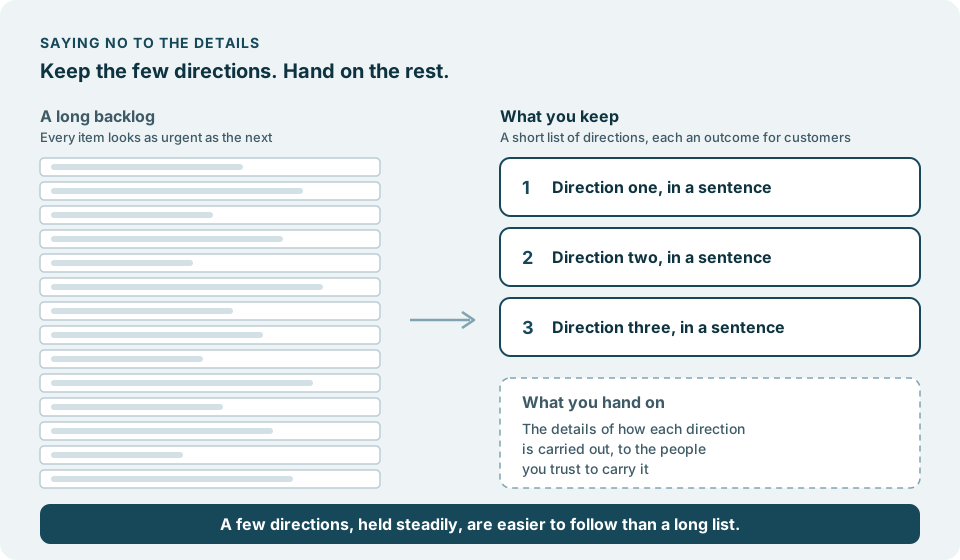
A backlog grows by yes. Each request is reasonable on its own, so each one gets a line. A customer asks for an export, a colleague wants a setting, a partner needs a field renamed. Months later the list is long, every line looks equally urgent, and nobody can say which three things the product is actually trying to become.
That is not a failure of discipline. It is what happens when the details are allowed to set the agenda. The cure is not a better list. It is a shorter one, made of directions rather than items, and a leader willing to say no to everything else.
A backlog is not a direction
A backlog answers the question “what could we do?” A direction answers a harder one: “where are we going, and for whom?”
The difference shows up the moment something new arrives. With only a backlog, a new request is weighed against hundreds of others, and the loudest usually wins. With a few clear directions, the question is simpler. Does this move us along one of them? If not, it waits, however polite the person asking.
A direction is written as an outcome someone outside the team would recognise. “New customers can set up an account without calling us.” “Our largest accounts can see their own usage.” It is not a feature list, and it says nothing about how the work will be done. That is the point. It leaves room for the people doing the work to find the best way there.
The decisions that stay with you
Some choices only a product leader can make, because they carry a judgement about what the product is for. These are the ones to keep.
Which directions, and in what order. Choosing the few things that matter this season is the core of the job. Nobody else has the view across customers, the market and the business that this choice needs.
What you will refuse. Saying which requests do not fit is as much a decision as saying which do. A leader who never refuses has quietly handed the direction to whoever asks most often.
What must not break. Every product has a few promises its customers rely on. Naming them is yours. How they are protected can be someone else’s craft.
When a direction has arrived. You decide whether the outcome you asked for is the outcome you got, and whether it is time to move on to the next one.
The details you can hand on
Almost everything else can be carried by someone you trust. The order of small tasks inside a direction. The name of a button. The choice between two reasonable ways to build the same thing. The upkeep that keeps a product healthy without changing what it does.
Handing these on is not the same as ignoring them. You still look at the result, and you still say no when it misses. What changes is that you stop carrying the steps in your head. You judge where the work ends up, not each move it made along the way.
A useful test: if a detail went the other way, would a customer notice a different product? If not, it is probably not yours to decide. If yes, it may belong to one of your directions, and you can say so.
Why a short list beats a long one
A long backlog feels thorough. It also hides the choices that matter among the ones that do not, and it invites everyone to work a little on everything.
A short list of directions does the opposite. It makes trade-offs visible, because there is no room to hide them. It gives the people doing the work a reason behind each task, so they can make good small decisions without asking. And it makes progress easy to see. When there are only a few directions, you can tell at a glance which ones are moving and which are stuck.
It also makes saying no kinder. “That does not fit what we are working towards” is an answer people can accept. “It is on the list” is a promise that usually goes unkept.
Choosing the few
There is no formula for this, and the choice stays a judgement. A few questions help.
Which outcome, if it arrived, would change how customers talk about the product? Which problem do you hear about from customers rather than from inside the team? Which direction would you regret not having started when you look back on the year?
Write the answers as plain sentences. If you have more than a handful, you have not chosen yet. Put the rest on a separate page called “not now”, so they are recorded without competing.
Then hold the course. A direction that changes every fortnight is a backlog in disguise. Give each one long enough to show whether it is working, and change it on purpose, not because the latest request was loud.
Saying no without closing the door
The hardest part is the conversation with the person whose request did not make the list. It helps to say why, in terms of the directions, and to say what would change your mind. A request that keeps coming back from different customers may be pointing at a direction you missed. That is worth hearing.
Saying no to the details is not saying no to people. It is saying yes, clearly, to a few things, and letting that clarity do the work a long list never could.
Where we come in
This is the part of the job we want to leave with you. “You set the direction. We carry the work through to shipped software.” You keep the few choices that shape the product, and you look at what arrives.
If your list has grown longer than your directions, let’s talk. It starts with a conversation, with no obligation.