- The Data Act sets rules for customers who want to leave a cloud service for another provider or for their own infrastructure.
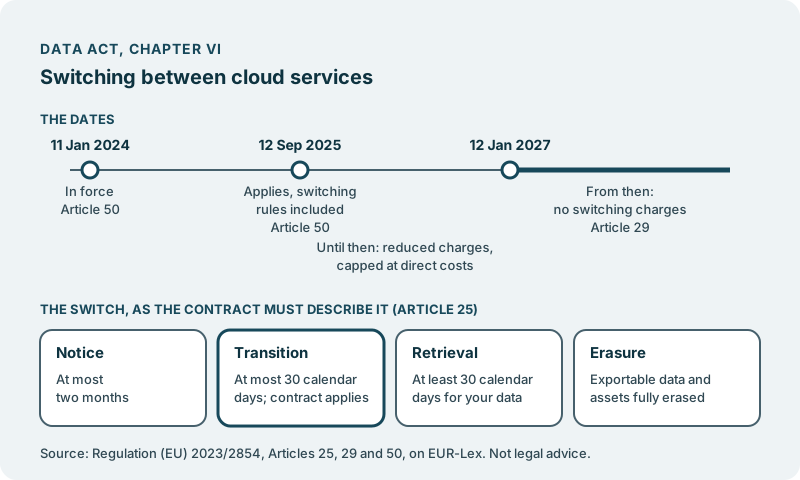
- The contract has to spell the switch out: notice, a transitional period, time to retrieve your data (Article 25).
- Switching charges are capped at the provider’s direct costs until 12 January 2027, and from that day they end (Article 29).
The Data Act is Regulation (EU) 2023/2854 of 13 December 2023, on harmonised rules on fair access to and use of data. Much of it is about data from connected products. Its Chapter VI, Articles 23 to 31, is about something closer to most product roadmaps: what happens when you want to leave a cloud provider.
Nothing in this guide is legal advice. Whether a given service or contract falls under these rules, and what they mean for you, is a question for your own advisers. Here is what the text says, with the article beside each point so you can check it yourself.
Which services the rules cover
The rules speak to providers of data processing services. Article 2 defines one as a digital service that gives a customer on-demand network access to a shared pool of configurable, scalable and elastic computing resources, provisioned and released with minimal management effort. In everyday terms, that is the family of hosted infrastructure, platforms and software your product is likely to run on.
Article 2 also defines switching: a customer moving from one data processing service to another offered by a different provider, or to its own on-premises infrastructure.
The dates, and what already applies
The Regulation entered into force on 11 January 2024 and applies from 12 September 2025 (Article 50). So on the date of this guide, 21 October 2026, the switching rules in Chapter VI already apply.
One date still lies ahead. Article 29 lets providers impose reduced switching charges until 12 January 2027. Those charges may not exceed the costs the provider incurs that are directly linked to the switch. From 12 January 2027, providers may impose no switching charges at all. The same article asks providers to tell prospective customers, before the contract is signed, about standard fees, early termination penalties and any reduced switching charges.
What the contract has to say
Article 25 asks for the customer’s rights and the provider’s obligations on switching to be set out in a written contract, made available before signing in a form the customer can store and reproduce. It lists what the contract must include at least. The terms most likely to matter to a product leader:
A notice period of at most two months for starting the switch.
A transitional period of at most 30 calendar days after the notice period, during which the contract still applies. During it, the provider gives reasonable assistance, acts with due care to keep the business running and keeps a high level of security.
A longer period only by notice. If 30 days is technically unfeasible, the provider must tell the customer within 14 working days of the switching request, give reasons and set an alternative transitional period of no more than seven months (Article 25).
A full list of what you can take. The contract specifies every category of data and digital assets that can be ported, including at least all exportable data.
At least 30 calendar days to retrieve your data after the transitional period ends.
Erasure afterwards. Once the retrieval period expires and the switch has been completed, the exportable data and digital assets are fully erased.
Article 23 adds a broader duty: providers may not put commercial, technical, contractual or organisational obstacles in the way of a customer who wants to terminate, sign with another provider or port their data. Article 26 asks providers to tell customers about the procedures and formats available for switching, and Article 27 asks everyone involved, the new provider included, to cooperate in good faith.
What this means for your own lock-in
A rule that makes leaving possible doesn’t make leaving easy. The contract can promise you a transitional period and a list of exportable data, and the switch can still stall on your side: a product wired so tightly to one platform that nothing runs anywhere else, or code that only the old setup understands.
So the useful questions sit with you, not the provider. If you had to move next quarter, what would you take with you, and would it run elsewhere? Who holds the code, and who could pick it up? Which parts of your product are yours, and which belong to the service they run on? Ask them at your next contract renewal, while nothing is urgent, and you can lift your eyes from the contract back to the product.
If the question is who carries the work, Hand the work back to your own team covers keeping that choice open.
Where we come in
We don’t advise on the Data Act, and we make no promise about any provider, contract or service and these rules. That judgement stays with you and your advisers.
If your product has outgrown the platform it started on, Move off the tool you started on describes the move to code you own. The work lands in your own code repository. The code we build for you is yours. You decide what ships. Nothing reaches your users without your approval.
It starts with a conversation, with no obligation.