What changes for you
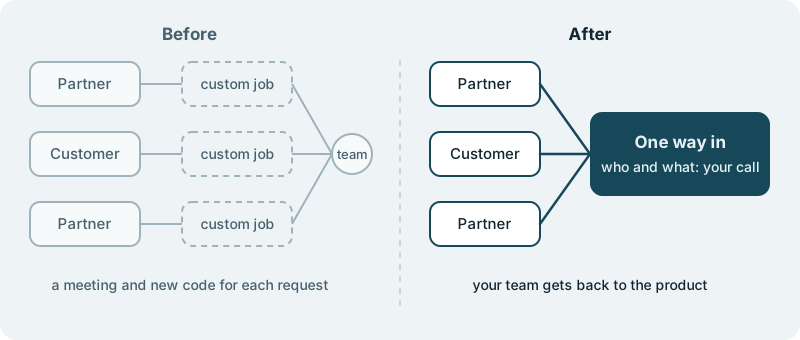
Partners and large customers get one way to connect to your product, and a request to integrate stops being a fresh project for your team.
Today the pattern is familiar. A large customer wants your data in their own system. A partner wants to send orders, users or updates into yours. Each request starts with a meeting, then a special arrangement, then a piece of code that only one partner uses. Your developers learn each partner’s quirks, and every new conversation pulls them away from the roadmap. Saying no costs you deals. Saying yes costs you focus.
With one way in, the conversation changes. A partner who wants to connect uses the same way in as every partner before them, and your team no longer writes something new for each one. The requests do not stop. They get shorter. Instead of “can you build us a connection”, the question becomes “may we connect”, and the answer is a decision you make rather than a project you staff. The work lands in your own code repository. The code we build for you is yours.
What you decide
You decide whether this is the right step. An API is a product of its own, with partners who will depend on it, so it is worth opening only when the requests are real and repeated.
You decide who may connect. Some products open to a short list of trusted partners first; others open to every customer on a given plan. That line is commercial as much as technical, and it belongs to you.
You decide what partners can reach. Which data they may read, which actions they may take, and what stays closed are choices about your business, your customers and your obligations to them.
You decide what you ask of partners in return. Terms of use, what a partner may do with your customers’ data and what happens when a partnership ends are agreements you set, often with your own legal adviser at the table.
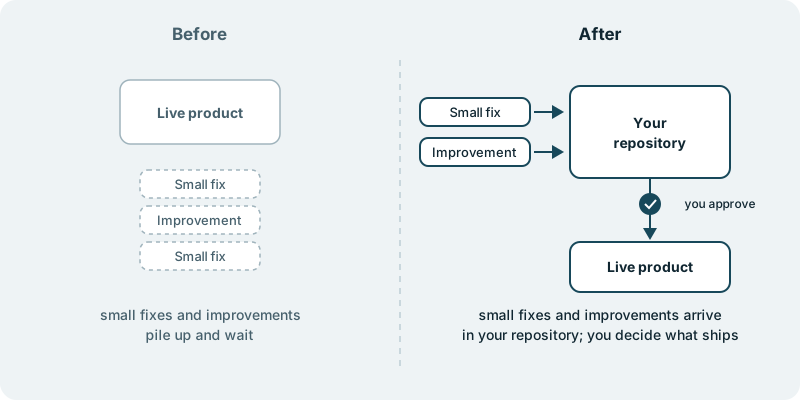
You decide when it goes live and when anything partners rely on changes. You decide what ships. Nothing reaches your users without your approval.
What you see along the way
Questions that are yours come to you plainly: whether a partner should see a given field, what a partner may do on a customer’s behalf, how an existing custom connection should be treated. They are put to you rather than guessed at.
What it costs you in time
A first conversation about which partners are asking and what they want, then short decisions as they come up. Your attention is worth most on the commercial questions: who gets in, on what terms, and what you are willing to share. Someone on your side who talks to partners is the best reader of the early pieces.
What if you want to stop
Your code and your product stay yours to take anywhere.
Starting small
There is no published delivery of a partner API from us to point to, and we will not suggest otherwise. A sensible first piece is the one thing partners ask for most often, opened to a single partner you trust, so you can see how it is used before you widen it. Every engagement is tailored to your product and your goals. It starts with a conversation, with no obligation.