What changes for you
You stop treating every upgrade as a project. Once a framework is past its support date, each new version of anything around it turns into a negotiation. This library no longer works with that one. This security fix cannot be taken without a larger change. The engineer you want to hire has never used the framework and would rather not start now.
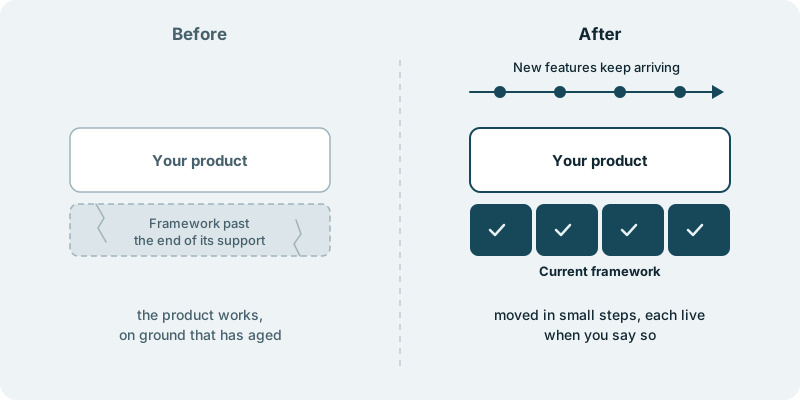
After the move, upgrading is ordinary again. Your team works on a framework that is current, documented and familiar to the people you want to recruit.
Waiting has a cost, and it rises. An end-of-life framework collects risk quietly. The longer it stays, the larger the eventual jump becomes, and the more of your team’s attention goes to keeping old ground from shifting instead of building on it. You may feel this long before you can put a date on it: estimates grow, small changes feel nervous, and “we should really upgrade” becomes a sentence nobody wants to finish.
The move does not need a pause in your product. Your users keep getting what they came for, and your roadmap keeps its place on the calendar. Your product keeps moving forward, week after week.
Where this fits
This is for products that still earn their keep but sit on something their makers have stopped supporting. It might be a front end on an old major version, a back end on a release that no longer gets security fixes, or a build setup that nobody dares to touch. The product works. It is the ground under it that has aged.
It is not a rebuild from scratch. If the product itself has outlived its purpose, or the code is beyond saving, the better path is a rebuild, and we will say so. When the product is sound and the framework is the problem, a move is usually the calmer choice.
What you decide
You decide the destination. A new framework is a long commitment, and it should fit your team and your plans for the next several years. For context, products delivered so far are built with TypeScript, Vue, Astro, and PHP with Laravel.
You decide the order. The part of the product that hurts your team every week can go first. So can the part that carries most of your revenue, or the part where an old dependency worries your security people. You set the direction, and you can change the order as you learn more.
You decide the pace. You may want the move to come first for a while, or to run as a slow, steady transition behind a busy release schedule. Both are reasonable.
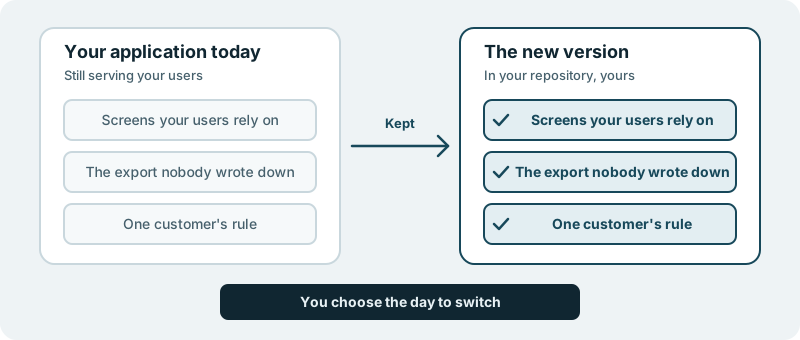
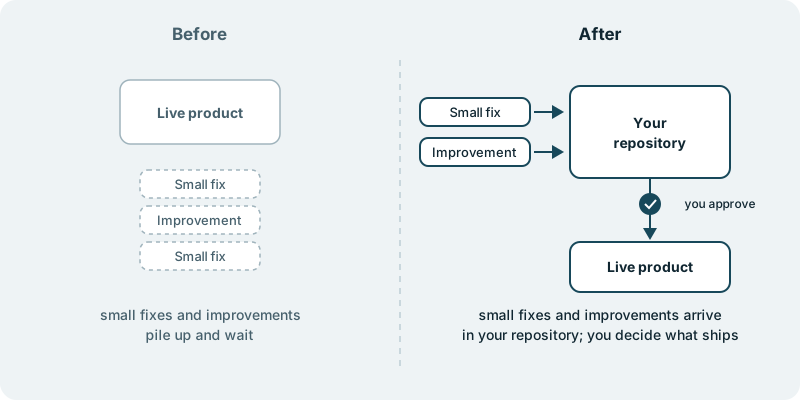
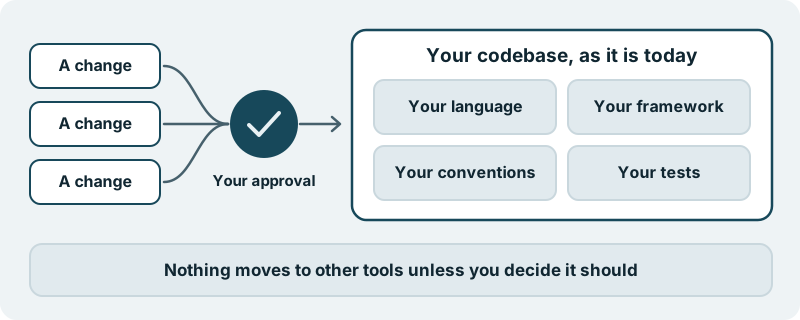
You decide what ships. Nothing reaches your users without your approval. A moved part goes live when you say so, and not before.
You decide whether to stop. Your code and your product stay yours to take anywhere, so pausing or ending the work never costs you what has already arrived.
What you see along the way
You see changes arrive in your own code repository. Your engineers can read them, question them, ask for something different or send them back.
You see your roadmap keep moving. New features are not queued behind the framework work. They carry on arriving.
You see the old framework shrink over time, until the parts that remain are the ones you have chosen to leave as they are.
What it costs you in time
A first conversation settles where the product stands and which area to try first. After that your part is to read what arrives, answer the questions that are yours to answer, and approve what ships.
If this is your situation
Start with a small first piece. Pick one area of the product that your team dreads touching, and see how it feels to move it before you decide anything larger. It starts with a conversation, with no obligation.