What changes for you
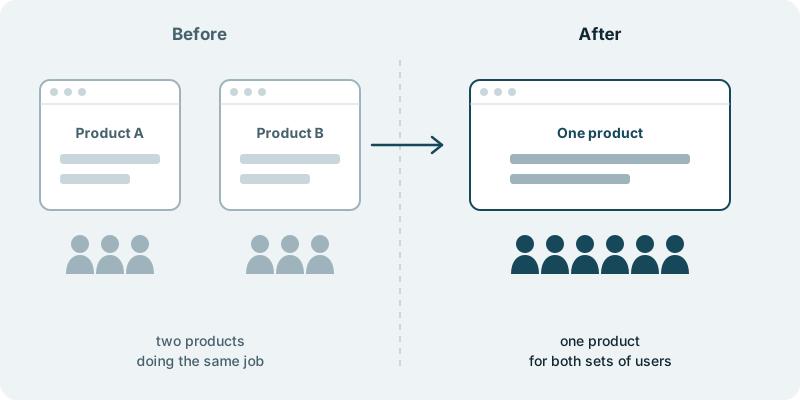
Two products doing the same job become one, and the one that remains keeps what each side’s users rely on.
The deal is signed and the press release is out. Then the questions start. Customers ask which product they should be on and whether theirs is going away. Sales teams from both sides pitch against each other without meaning to. Support answers the same question in two places, in two sets of words. The board asks why the combined company still builds, fixes and pays for two of everything when the reason for the deal was to become one.
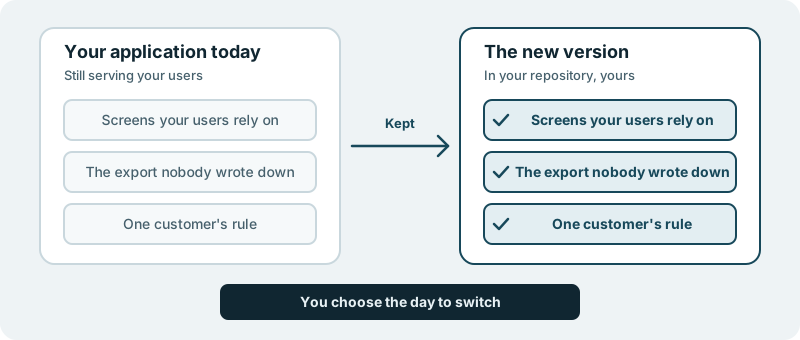
Each product has users who chose it for a reason. Some of those reasons are written down in a feature list. Many are not: a report a finance team opens every Monday, a shortcut a heavy user depends on, a field that one large customer’s integration reads. Lose one of those, and a customer who was happy before the deal starts looking elsewhere after it.
What you want is one product your whole customer base can stand behind, and you want to reach it without switching either product off while the work is under way. Both sets of customers keep working in the product they know until the combined one is ready for them, and they move when you decide they should.
The combined product lands in your own code repository, and the code we build for you is yours. Your teams from both companies can read it, own it and carry it on.
If one of the two products is simply old and needs replacing, Rebuild a legacy web application covers that situation. If what you are really replacing is an internal system your staff work around, see Replace the back-office system your staff work around.
What you decide
You set the direction. We carry the work through to shipped software.
You decide which product, or which parts of each, the combined one starts from. It is often as much a decision about people and contracts as about code, and it is yours to make.
You decide what each side’s users must keep. Your product, support and customer teams from both companies know what their customers ask for, and that knowledge shapes what the combined product has to do.
You decide the order in which customers move, and which ones move first. A small group you trust, a single region or a single plan can go first while everyone else stays where they are.
You decide what ships. Nothing reaches your users without your approval.
What you see along the way
When a piece does not fit what either side’s customers need, you tell us, and it is changed before it reaches them.
What it costs you in time
A first conversation about the two products, the customers on each and what the deal was meant to achieve. After that, time from a few people on each side who know their customers well. They are the ones who can say which feature a large account would leave over and which one nobody would miss.
What if you want to stop
Every piece you approved is already in your repository, and both original products are still running for the customers who use them. Your code and your product stay yours to take anywhere.
Starting small
A sensible first piece is one part of the job that both products do, brought together for one group of customers, so that you can see how they take it before anything more moves. Every engagement is tailored to your product and your goals. It starts with a conversation, with no obligation.
If your company now has two products doing one job, tell us which customers you most need to keep.