There is a moment in every product leader’s week when a direction has to leave their head. It might go to a team, a new hire, a partner or a supplier. Whoever receives it will make dozens of small choices you will never see. The only thing you can be sure they take with them is what you wrote down.
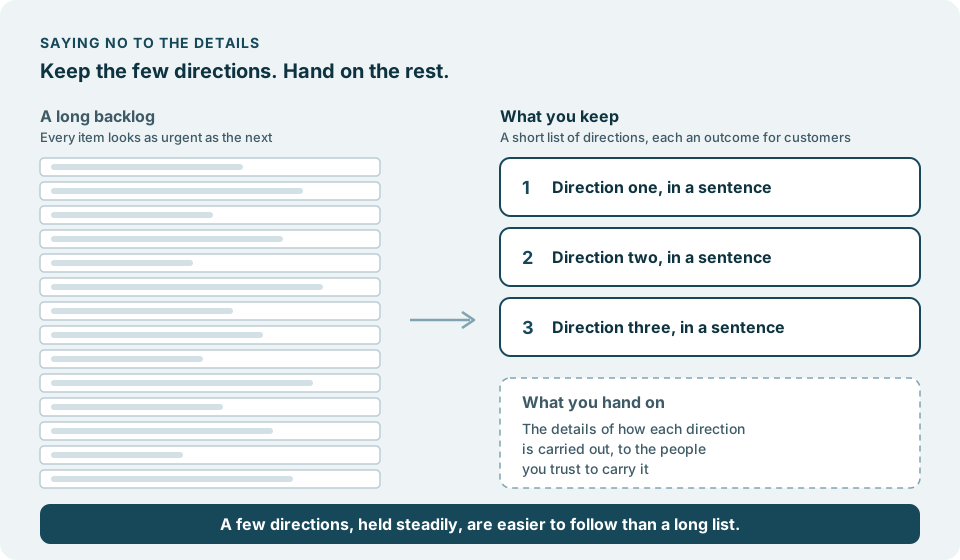
Most of us write too much. We describe the screens we imagine, the order we would do things in, the edge cases we happen to remember. It feels generous. In practice it hands on our details and leaves the direction itself buried somewhere in the middle.
A good brief does the opposite. It fits on one page, and everything on that page is something only you could have decided.
Why one page
One page is a constraint, and the constraint is the point.
A long brief lets you avoid choosing. Every idea gets a paragraph, so nothing has to be ranked. A single page forces the question every direction needs answered: of all the things you could say, which ones would change the result if they were missing?
It also changes who does the thinking. A brief that spells out every step asks the reader to follow. A brief that states the destination and the limits asks the reader to find the way. The second kind of reader brings their own judgement, and their judgement is usually the reason you handed the work on in the first place.
What the page holds
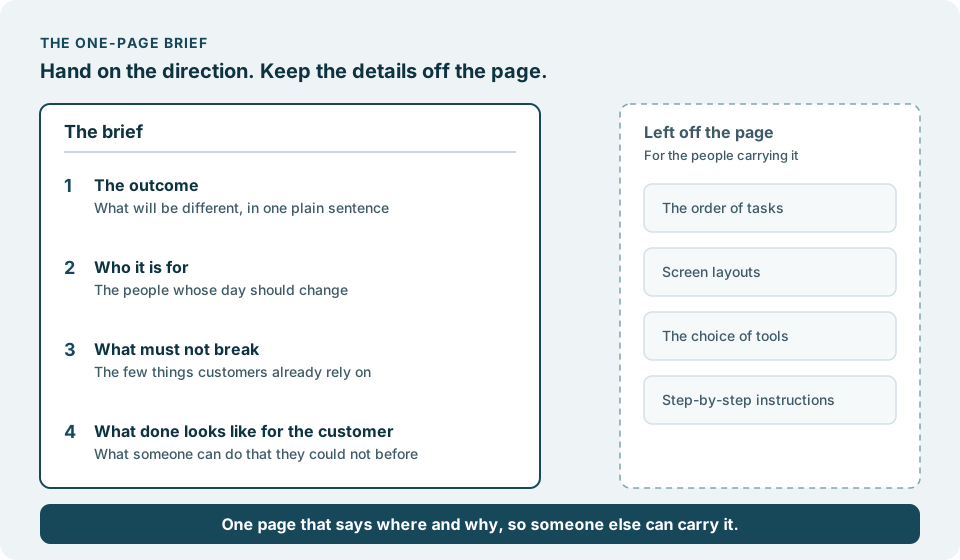
Four parts are enough. If one of them is missing, the direction is not ready to hand on yet.
The outcome. One or two sentences about what will be different for someone outside the team. “A new customer can invite their colleagues without asking us.” “Finance can close the month without exporting anything by hand.” Write it so that a customer would recognise it, not so that an engineer would know where to start.
Who it is for. Name the people whose day should change. Not “users”, but the specific group: the administrator at a mid-sized customer, the person who signs the renewal, the support colleague who answers the same question every week. When the reader faces a choice you did not foresee, this is the line they will come back to.
What must not break. Every direction runs close to something customers already rely on. A billing flow, an integration a large account depends on, a promise made in a contract. List the few that matter. This is the part people most often leave out, and the part that matters most when the direction is in someone else’s hands.
What done looks like for the customer. Describe the moment you would call the direction arrived, from the customer’s side. “An administrator sets up a team of twenty without a support ticket.” Not “the feature is built”, but what someone can now do that they could not do before. This is how you and the person carrying it will agree, at the end, that you got what you asked for.
What the page leaves out
What you leave out matters as much as what you put in.
The how. The order of the work, the design of each screen, the choice between two reasonable ways to build it. If you write these down, they stop being suggestions. The reader will follow them even when they find a better way, because the page told them to.
Your guesses about the solution. You may well have a picture of the answer in mind. Hold it back, or mark it clearly as one possibility among several. A brief that describes the problem well often gets a better answer than the one its author imagined.
Everything that is true but not decisive. The history of how the idea came up, the three meetings where it was discussed, the competitor who did something similar. Useful background, perhaps, but it belongs in a conversation, not on the page that has to carry the direction.
Promises about dates you have not agreed. A brief that says “by the end of the month” before anyone has looked at the work turns a direction into a deadline. If timing matters, say why it matters, and leave the date to the conversation that follows.
Writing it
Start with the outcome and do not move on until it reads as one plain sentence. If you need a paragraph to say what will be different, you have more than one direction, and each deserves its own page.
Then write the other three parts in short lines. Read the page as if you were the person receiving it, with none of the context in your head. Could you make a good decision on a Thursday afternoon, with nobody to ask, using only this page? If not, something is missing. If you find yourself wanting to add instructions, look again at the outcome. It is probably not clear enough yet.
Finally, take something out. Almost every first draft carries one detail its author could not let go of. That line is usually the one that would have narrowed the work the most.
What changes when the page is short
A short brief is easier to remember, which means it actually gets used. People come back to a single page when they are unsure. They rarely come back to a long document.
It also makes it easier to say no along the way. When a request arrives in the middle of the work, the brief gives a quick answer: does this serve the outcome, for these people, without breaking what must not break? If not, it waits. Nobody needs to come and find you to ask.
And it keeps your attention where it belongs. Once the direction is written down well, you no longer need to hold the details in your head. You can lift your eyes to the next direction, and look back at this one when there is something to judge: the outcome you asked for, and whether it arrived.
Where we come in
“You set the direction. We carry the work through to shipped software.”
If you have a direction you would like to hand on, let’s talk. It starts with a conversation, with no obligation.