What changes for you
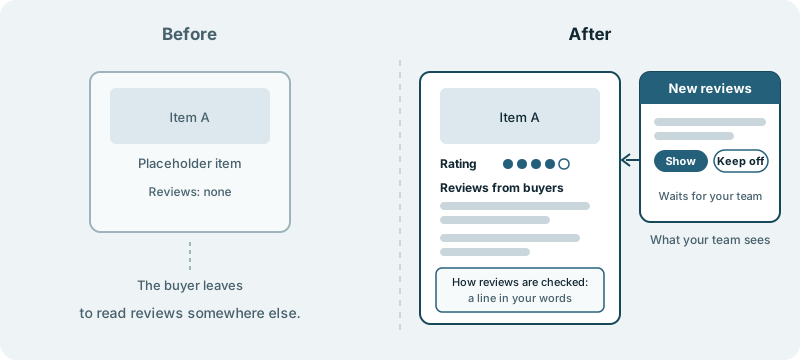
Customers who bought an item can give it a rating and write a short review on its page. Your team looks at each new review before it shows. Next to the reviews, a short line tells buyers how reviews are checked.
Today a buyer on one of your product pages wants to know one thing the page cannot tell them: what did other people think once they had it? Many buyers look for that answer before they pay. When your page is silent, they go and find it elsewhere, and the place that answers the question is often the place that gets the order.
With reviews, the answer sits on your own page. Under the item, a buyer sees the rating it has been given and the short reviews customers wrote. The reviews come from people who bought the item, not from anyone who happens to pass by, and the reviews shown are the ones they wrote, in their own words.
Before a review appears, someone on your team looks at it. That gives you a moment to keep out what does not belong on a product page, such as a message meant for customer service or a review posted on the wrong item. It does not give anyone a way to change what a customer said.
Buyers are told how this works. A short line on the page explains who can leave a review and that your team looks at each one before it shows. A buyer who reads the line knows what the reviews on the page are, and what they are not.
There is also a legal side, and this page is not legal advice. In the EU, Article 7(6) of Directive 2005/29/EC, added by Directive (EU) 2019/2161, treats as material information whether and how a trader that gives access to consumer reviews makes sure they come from consumers who have actually used or bought the product. What that asks of your pages is for you and your advisers to judge.
That is the scope of this page: a rating and a short review from buyers, your team’s look before each one shows, and the line on how reviews are checked. If you do not sell online yet, start with launching an online shop; reviews sit on the product pages it gives you.
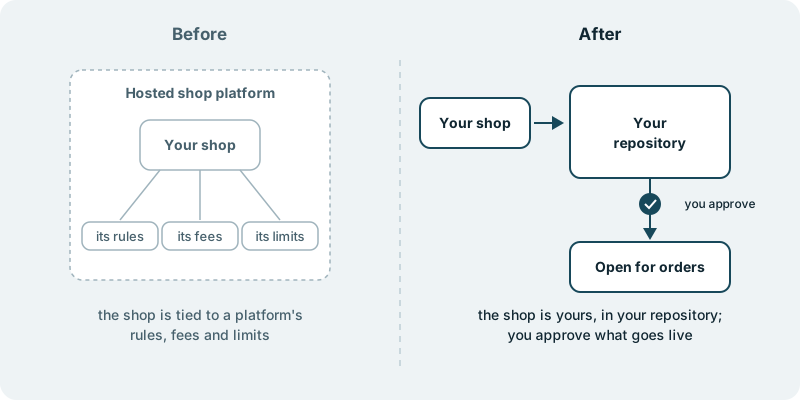
The work lands in your own code repository. The code we build for you is yours.
What you decide
You decide which products can be reviewed. It may be your whole range, or a few items you want to try it on first.
You decide who on your team looks at new reviews, and what reasons they have for keeping one off the page. Writing those reasons down once makes the choice easier for whoever looks next.
You decide the wording of the line on how reviews are checked, so it matches what your team really does.
You decide what ships. Nothing reaches your users without your approval.
What you see along the way
The choices that are yours come to you in plain words: which products, who looks at new reviews, and what the line on the page says.
Each piece of the review feature arrives in your repository, open for you to read. You can buy an item as a test customer, leave a rating and a review, see it wait for your team, and watch it appear on the page once it is let through. If the review form or the line about checking reads wrong to you, it does not reach your customers until it reads right.
What it costs you in time
A first conversation about your product pages, the questions buyers ask before they pay, and who on your team would look at new reviews. After that, a short answer when a choice comes up. The people who already read what customers say about your products are the ones to bring.
What if you want to stop
You can stop when you choose. Your code and your product stay yours to take anywhere, including the review feature as far as it got.
Starting small
This page describes something we can build for you; we have not delivered it for a customer before. A good first piece is reviews on one product line, with your team looking at each one and the line on the page in place, so you can see how buyers use them before they spread across your range. Every engagement is tailored to your product and your goals. It starts with a conversation, with no obligation.