What changes for you
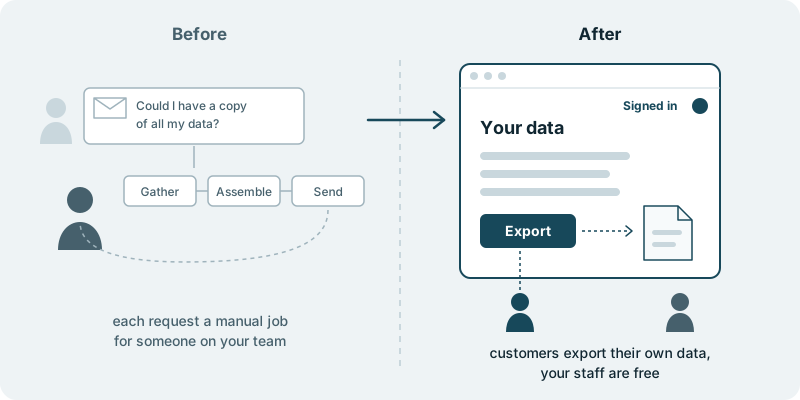
A request for “a copy of my data” stops being a small project. Today a customer writes in because they want what they have put into your product: to keep a record, to move it into another tool, or simply to know what you hold. Someone on your team finds it in several places, assembles it into something readable, checks it belongs to the right person and sends it back. Each request is handled from scratch, and each one waits until someone has the time.
An export inside your product changes who does that work. A customer signs in, goes to the place you have chosen and exports their own data. Your team no longer has to put a file together by hand, and the customer does not wait in a queue for a reply.
There is a quieter benefit too. A product that lets customers leave with what is theirs tends to feel safer to stay with. The export says something about how you treat the people who use your product.
One distinction is worth keeping clear. This page is about your customers’ data: the records, entries and files they put into your product. It is separate from your own code. The export is built for you and lands in your own code repository, and the code we build for you is yours. Your customers’ data is a different matter, and how you handle it stays your decision.
What you decide
You decide what an export holds. Most companies start from what their team already sends when someone asks, because that reflects what customers expect. You may want to add something customers have asked for, or leave out internal notes that were never meant for them.
You decide who may export what. A single person, an account owner, an administrator: each of those can mean a different set of data, and where the line sits is a business question, not a technical one.
You decide where the export lives in your product and how it is worded, so it reads as part of your service. You also decide how to introduce it: some companies mention the export in their reply to the next request, while others add it to their help pages first and see how it is received. You decide what ships. Nothing reaches your users without your approval.
Data protection law has a say in this area too. In the EU, Article 20 of the General Data Protection Regulation deals with data portability. What it asks of your product, if anything, is a question for your legal advisers, and we leave that judgement to them.
What you see along the way
You see the export take shape in your repository, as small changes your team can read and approve. A choice that is yours, such as what a customer sees when they press the button, reaches you with the question and a link.
What it costs you in time
A first conversation about the requests you receive, who handles them and what they send back. After that, some time from the person who answers those requests today. They know what customers ask for and where the data is found, and that knowledge shapes an export customers can use.
What if you want to stop
Whatever you have approved by then remains in your repository. Your team can carry on handling requests by email exactly as before, so customers lose nothing they rely on. Your code and your product stay yours to take anywhere.
Starting small
We have not built a customer export of this kind for anyone yet, and we will not suggest otherwise. A sensible first piece is a single export covering the data customers ask for most, so you can see whether those requests ease before deciding what comes next. Every engagement is tailored to your product and your goals. It starts with a conversation, with no obligation.