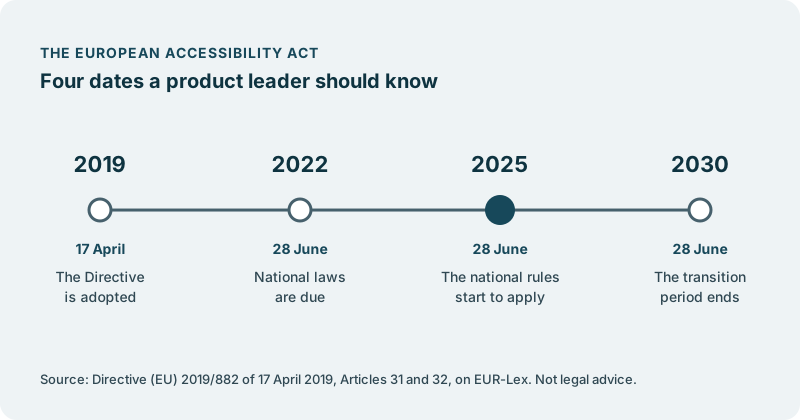
Most laws land on the legal team’s desk. This one lands on the roadmap. The European Accessibility Act is Directive (EU) 2019/882, adopted on 17 April 2019, and the national rules that carry it have applied since 28 June 2025. If you sell digital products or services to consumers in Europe, it is worth knowing what the text actually asks.
This is not legal advice, and nothing here tells you whether your product meets the law. That judgement belongs to you and your advisers. What follows is what the text says, in plain terms, with the source linked so you can read it yourself.
It is a directive, so your country’s law is the one that counts
The Directive sets the rules, and each Member State carries them into its own law. Under Article 31, Member States had to adopt those laws by 28 June 2022 and apply them from 28 June 2025. The Directive also leaves enforcement and penalties to each Member State.
In practice, the wording your customers’ country uses may differ in its details from the Directive. EUR-Lex lists the national measures each country has reported. Read the version that applies where you sell, not only the summary someone sent you.
Who it covers
It covers specific products and services, named in Article 2, most of them offered to consumers. For a product leader, the services are usually the part that matters:
- e-commerce services;
- consumer banking services;
- e-books and the software made for reading them;
- electronic communications services, and services that give access to audiovisual media;
- parts of passenger transport by air, bus, rail and water, such as websites, mobile apps and electronic tickets.
On the product side, the list includes consumer computers and their operating systems, self-service terminals such as cash machines and ticket machines, consumer devices used for electronic communications, and e-readers.
The e-commerce line is wider than it sounds. Article 3 defines an e-commerce service as one provided at a distance, through websites and mobile apps, at a consumer’s request, with a view to concluding a consumer contract. Many products that never call themselves a shop sell something to a consumer somewhere in the flow.
There is one clear exemption. Under Article 4, microenterprises that provide services are exempt from the accessibility requirements. Article 3 defines a microenterprise as one with fewer than 10 persons and an annual turnover or balance sheet total of no more than EUR 2 million. The exemption is for services, not products.
What it asks of a service
It asks two things: that people with disabilities can use the service, and that you say how they can.
The first is set out in Annex I. For websites and mobile apps, it asks that they be made accessible “in a consistent and adequate way by making them perceivable, operable, understandable and robust”. Those are the same four principles that organise the Web Content Accessibility Guidelines (a vocabulary many web teams already know). The Annex also covers the information about the service itself, and, where they exist, the support services that come with it.
The second is in Article 13 and Annex V: a service provider publishes information on how the service meets the requirements, in a form that is accessible to people with disabilities. That statement is written in words, but it is only true if the product agrees with it.
Article 15 adds a presumption of conformity for products and services that meet harmonised standards whose references are published in the Official Journal. Check what has been published for what you sell before you rely on it.
Where the text gives room
The requirements have limits, and they come with paperwork. Under Article 14, they apply only as far as they do not fundamentally alter the basic nature of the product or service, or impose a disproportionate burden. A business that relies on this has to make its own assessment against the criteria in Annex VI, and document it.
Article 32 sets a transition period ending on 28 June 2030. Service providers may keep using products they lawfully used for similar services before 28 June 2025, and service contracts agreed before that date may run until they expire, but no longer than five years from it. Member States may also let self-service terminals already in use stay in use until the end of their economically useful life, up to twenty years after they entered into use.
Whether any of this applies to your product is a question for your advisers. What you can decide on your own is the direction the product takes from here.
What this means for the roadmap
The law reads like a deadline. For a product, it behaves more like a quality you either keep or lose with every change you ship.
Start where people complete something. Sign-up, sign-in, search, checkout and account settings carry most of what your users came to do. A product where those journeys work with a keyboard and a screen reader is a different product from one with a clean report.
Make new work meet the level from the start. Retrofitting is the expensive way to do this, and it never ends, because every release adds something new to retrofit. A level that every new feature has to reach before it counts as finished stops the backlog from growing.
Keep your statement and your product in step. The published information is a promise to your users. If the product changes and the statement does not, one of them is wrong.
Write your decisions down. Where a part of the product cannot reach the level yet, record why and what happens next. That record is useful to your team whether or not anyone else ever asks for it.
Ask your advisers the legal questions early. Scope, exemptions and the transition rules are theirs to answer. You will make better roadmap choices once you know their answer than while you are guessing it.
None of this needs to sit at the top of every meeting. Settle it once, hold the level, and you can lift your eyes from the article numbers to the people your product is for.
Where we come in
We do not give legal advice, and we never promise compliance. Our own website is the example we can point to: This website is held to WCAG 2.1 level AA on every page.
On your product, we can take on the work itself: making the journeys that matter usable with a keyboard and a screen reader, and holding new work to the level you choose. The work lands in your own code repository. The code we build for you is yours. You decide what ships. Nothing reaches your users without your approval.
It starts with a conversation, with no obligation.