What changes for you
Your customers get the documents they ask for straight from your product, as files they can download, and your team stops making them by hand.
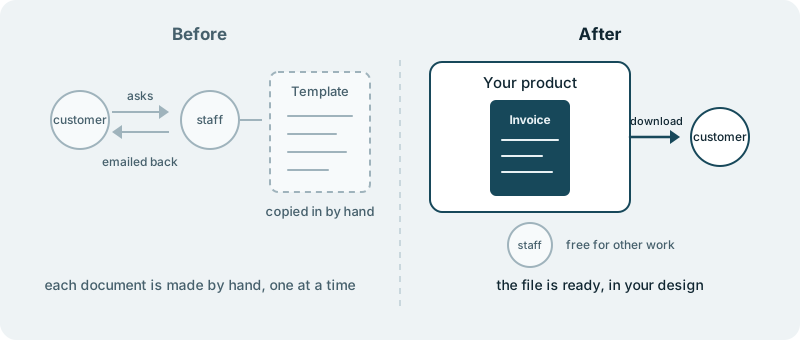
The situation is familiar in many products. A customer needs an invoice for their accounts team, a certificate for an audit, or a confirmation to forward to a colleague. They email and ask. Someone on your team opens a template, copies in the name, the dates and the figures, checks it, saves it and sends it back. Then the next request arrives, and the one after that. Each document takes a few minutes, mistakes creep in when details are copied across, and customers wait for a reply to get something that already exists in your product as data.
With this in place, your product makes those documents itself. A customer opens the order, the booking or the account, and the document is there to download, already in your design, with the details your product holds. They can keep it, file it with their records and forward it to whoever needs it. Your team no longer types the same details into the same template, and the requests that used to fill the inbox thin out.
For your customers, the difference is that they no longer have to ask. The document they need is where they expect to find it, and it looks like it came from you, because it did. For your team, time that went into assembling files goes back to work that needs a person.
This is narrower than some neighbouring work, and that is part of its value. If customers mostly want figures to read on screen, reports inside your product may serve them better. If they want to check orders and change details on their own as well, a self-service portal covers that wider ground. The work lands in your own code repository. The code we build for you is yours.
What you decide
You decide which documents your product should make. Invoices, certificates and confirmations are common starting points, but the list belongs to your business and to what your customers actually ask for.
You decide what each document contains. Which details appear, which stay inside your product, and how each one is worded are questions about your customers and your obligations to them.
You decide how the documents look. Your logo, your layout, your wording. A document that reaches a customer’s accounts team represents you, and its design is yours to set.
You decide whether any document needs to meet a rule in your market, and you check that with the people who advise you. We build what you decide; whether it satisfies a given requirement is for you and your advisers to confirm.
You decide who may download what. A customer should see their own documents and nobody else’s, and you set where that line falls for your users.
You decide when it goes live and when anything your customers rely on changes. You decide what ships. Nothing reaches your users without your approval.
What you see along the way
Questions that are yours come to you plainly: which details belong on a document, how a field should be labelled, who should be able to download it. Nobody guesses at them on your behalf. The work reaches your repository in small, readable pieces, so your team can follow each document as it takes shape.
What it costs you in time
A first conversation about which documents your team makes by hand today and what each one needs to show, then short decisions as they come up. Your attention matters most on content and design. Someone on your side who makes these documents now is the best reader of the early pieces.
What if you want to stop
Your code and your product stay yours to take anywhere.
Starting small
We have no published delivery of this kind to show you, and we will not pretend to. A sensible first piece is the single document your team makes most often, offered to a few customers you trust, so you can see it in use before you add more. Every engagement is tailored to your product and your goals. It starts with a conversation, with no obligation.